
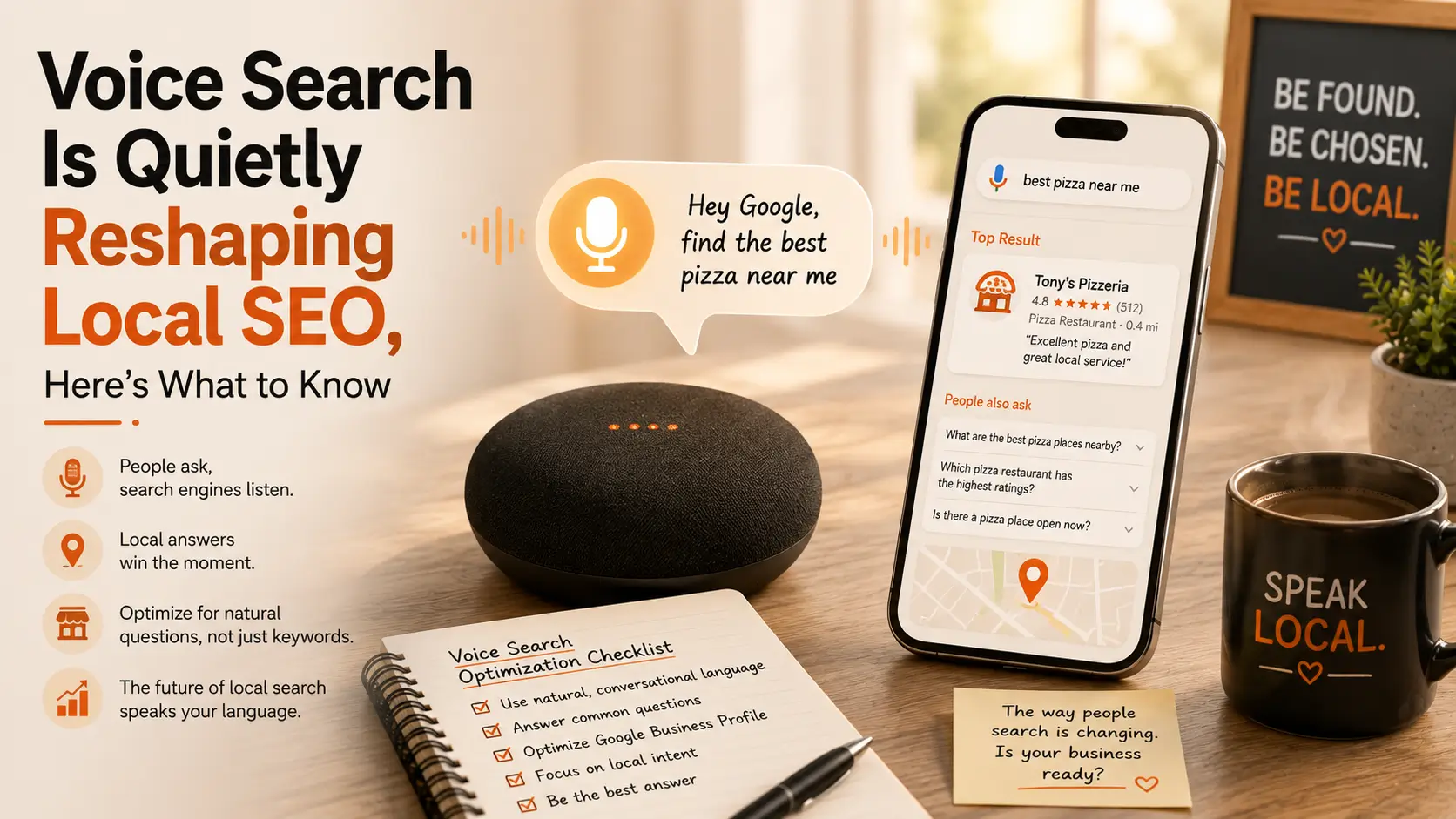
“Hey Google, find a coffee shop near me that’s open right now.” That kind of spoken query looks completely different from what someone types into a search bar, shorter, more conversational, more specific to a location and moment in time. As voice assistants become a routine part of daily life, that shift in how people search is worth paying attention to, especially for local businesses.
How Spoken Queries Differ From Typed Ones
People type in fragments, “best pizza Chicago,” but they speak in full questions, “what’s the best pizza place near me.” Voice queries tend to be longer, more natural, and more likely to include phrases like “near me,” “open now,” or “how do I get to.” This shift toward conversational phrasing means content written in a natural, question-and-answer style tends to align better with how people are actually asking, compared to content built around short, clipped keyword phrases.
The Local Angle That Makes This Matter
A large share of voice searches carry local intent, someone asking about a nearby business while cooking, driving, or otherwise not looking at a screen. For these searches to surface a business accurately, the underlying data needs to be solid: correct hours, current address, an accurate phone number. This is where accurate, consistent listings on your website, your Google Business Profile, and directories like Verfied Zip do real work, they’re part of the information voice assistants pull from when answering a spoken question about nearby options.
Practical Steps That Actually Help
You don’t need a dedicated voice search strategy so much as a commitment to clarity. Write an FAQ section on your website using the actual questions customers ask out loud, “do you take walk-ins,” “is there parking nearby,” phrased the way people would say them. Keep your hours and location information airtight across every platform where your business appears. None of this requires new technology, just attention to detail applied with voice search’s more conversational nature in mind.
Conclusion
Voice search isn’t a separate discipline from local SEO so much as an extension of it, one that rewards businesses with clear, accurate, consistently published information even more directly. Getting the fundamentals right pays off across both spoken and typed searches alike.
Frequently Asked Questions
Not entirely separate content, but framing some of your existing content as direct answers to common spoken questions helps. An FAQ page written in natural, conversational language tends to serve both voice and traditional search well.